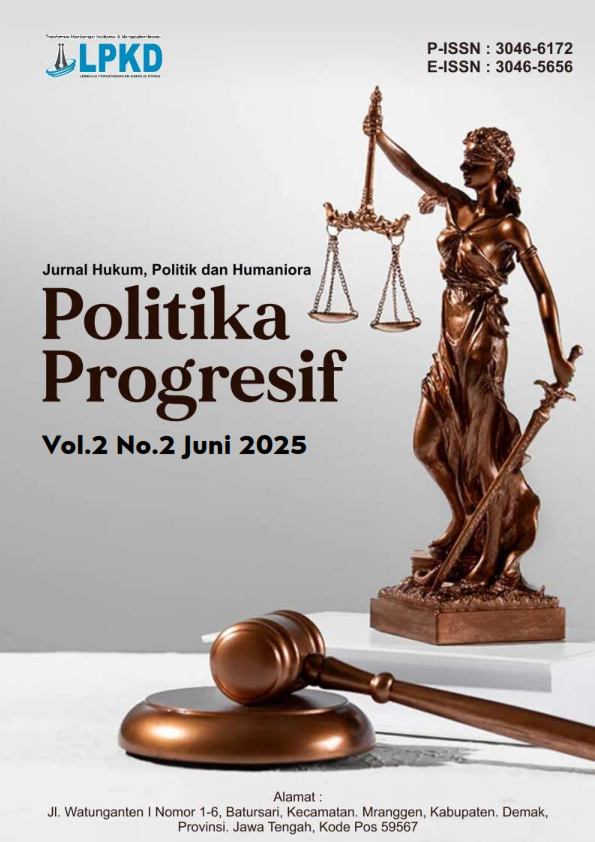
Analisis Kewenangan Diskresi Kepolisian dalam Proses Penyidikan Perkara Tindak Pidana Pencemaran Nama Baik
DOI:
https://doi.org/10.62383/progres.v2i2.1698Keywords:
Defamation, Discretion, PoliceAbstract
The implementation of police discretion in the process of investigating criminal defamation cases shows that discretion is an important instrument for police officers in assessing, determining, and following up on a criminal report based on urgency, public interest, and the principles of proportionality and professionalism. In cases of defamation, which are often subjective and private, discretion allows investigators to consider various factors such as motive, impact, and the possibility of resolution outside the criminal path. Factors Affecting the Implementation of Police Discretion in the Process of Investigating Criminal Defamation Cases show that discretion is not carried out absolutely, but is influenced by various internal and external factors, namely: Legal and Regulatory Aspects, Case Characteristics, Professionalism and Ethics of Investigators, Social and Environmental Pressure, Facilities and Resources. Police Discretion should be regulated more clearly in positive law other than Law Number 2 of 2002 and the Criminal Procedure Code so that the principles of Legal Certainty and Respect for Human Rights are more apparent. Police offices need to provide special facilities such as mediation rooms that are neutral, comfortable, and support the creation of a dialogical atmosphere between the disputing parties. Increasing the number of investigators and managing a more balanced workload will provide space for investigators to consider the discretionary path more seriously without sacrificing work efficiency. The Standard Operating Procedure (SOP) for discretion at the Polres level needs to be adjusted to local socio-cultural characteristics. In Gorontalo, for example, a legal approach that is sensitive to family values and customs must be officially accommodated in work procedures.
References
Abdulkadir, M. (2004). Hukum dan penelitian hukum. Citra Aditya Bakti.
Abdussamad, Z. (2021). Buku metode penelitian kualitatif. Syakir Media Press.
Alston, P., & Suseno, F. M. (2008). Hukum hak asasi manusia. Pusat Studi Hak Asasi Manusia, Universitas Islam Indonesia.
Amiruddin. (2018). Pengantar metode penelitian hukum. PT Raja Grafindo Persada.
Djulaeka, & Rahayu, D. (2020). Buku ajar: Metode penelitian hukum. Scopindo Media Pustaka.
El Muhtaj, M. (2005). Hak asasi dalam konstitusi Indonesia. Prenada Media.
Fagih, M. (1999). Panduan pendidikan politik rakyat. Insist Press.
Hartono, J. (2018). Metoda pengumpulan dan teknik analisis data. Penerbit Andi.
Husen, H. M. (1990). Kejahatan dan penegakan hukum di Indonesia. Rineka Cipta.
Komnas HAM. (2013). Pembangunan berbasis hak asasi manusia. Komnas HAM.
Kusniati, R. (2011). Sejarah perlindungan hak-hak asasi manusia dalam kaitannya dengan konsepsi negara hukum. Jurnal Ilmu Hukum, 4(5), [halaman tidak dicantumkan].
Marzuki. (2019). Metodologi riset. PT Hanindita Offset.
Masdewi, N. K., et al. (2020). Penyelesaian kasus pelanggaran HAM yang dilakukan oleh kantor wilayah hukum dan HAM Provinsi Bali. Jurnal Analogi Hukum, 2(1), [halaman tidak dicantumkan].
Nowak, M. (2003). Introduction to the international human rights regime. Martinus Nijhoff Publishers.
Plaituka, S. B. (2017). Penanganan pelanggaran HAM oleh Kantor Wilayah Kementerian Hukum dan HAM Nusa Tenggara Timur melalui pelayanan komunikasi masyarakat. Jurnal Rechtsvinding, 6(1), [halaman tidak dicantumkan].
Siagian, S. P. (2005). Manajemen stratejik. Bumi Aksara.
Smith, R. K., et al. (2009). Hukum HAM. Pusham UII.
Soekanto, S. (2006). Pokok-pokok sosiologi hukum. RajaGrafindo Persada.
Steers, R. M. (1985). Efektivitas kerja. PT Gramedia Pustaka Utama.
Strees, R. M. (1990). Efektivitas organisasi. Airlangga.
Syahuri, T. (2004). Hukum konstitusi: Proses dan prosedur perubahan UUD di Indonesia 1945–2002. Ghalia Indonesia.
Undang-Undang Nomor 23 Tahun 2022 tentang Penanganan Dugaan Pelanggaran Hak Asasi Manusia.
Undang-Undang Nomor 39 Tahun 1999 tentang Hak Asasi Manusia.
Yolanda, M. S., et al. (2003). Pendekatan teori efektivitas hukum dalam penyelesaian kasus dugaan malpraktik yang dilakukan oleh dokter. Jurnal Ilmu Sosial dan Pendidikan, 7(2).
Downloads
Published
How to Cite
Issue
Section
License
Copyright (c) 2025 Politika Progresif : Jurnal Hukum, Politik dan Humaniora

This work is licensed under a Creative Commons Attribution-ShareAlike 4.0 International License.