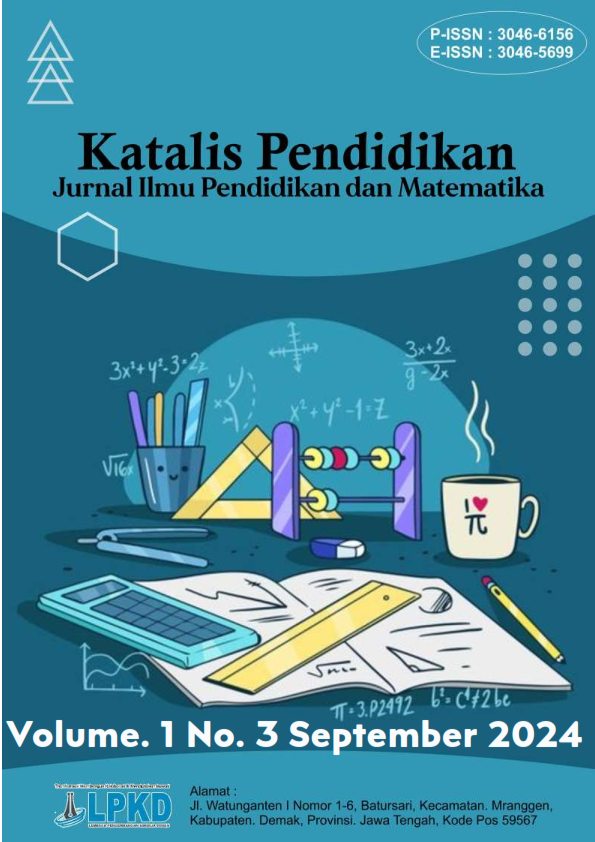
Pengaruh Model Pembelajaran Creative Problem Solving, Teknologi Pendidikan, Dan Gaya Belajar Siswa Terhadap Kemampuan Berfikir Kritis Sebagai Implementasi Kurikulum Merdeka Mata Pelajaran IPAS SDN Karawang Tahun 2023/2024
DOI:
https://doi.org/10.62383/katalis.v1i3.503Keywords:
Creative problem solving, independent curriculum, educational technology, learning stylesAbstract
This study aims to explore the effect of the Creative Problem Solving (CPS) learning model, educational technology, and student learning styles on critical thinking skills as an implementation of the Merdeka Curriculum in IPAS subjects at SDN Banyusari Karawang in 2023/2024. The research method used is a quantitative approach with descriptive and inferential statistical analysis. Data were collected through tests, questionnaires, and documentation from 264 students selected as research samples. Data analysis included description, prerequisite tests, and hypothesis testing using ANOVA and post hoc techniques. The results showed that the CPS learning model significantly improved students' critical thinking skills compared to the conventional learning model. The use of educational technology also contributes positively to the improvement of critical thinking skills, although the difference is not too striking. Kinesthetic learning style proved to be more effective in developing critical thinking skills compared to audio and video learning styles. ANOVA test indicated a significant effect of learning model and educational technology on critical thinking skills, while learning style showed a smaller effect. The conclusion of this study is that the application of the CPS learning model and the integration of educational technology in the Merdeka Curriculum can effectively improve students' critical thinking skills in IPAS subjects. Therefore, it is recommended for teachers to apply student-centered learning models and utilize educational technology to support the learning process.
References
Abdullah, et al. (2022). Metodologi Penelitian Kuantitatif. Yayasan Penerbit Muhammad Zaini.
Mufidah, L.-L. N. (2017). Memahami gaya belajar untuk meningkatkan potensi anak. Martabat, 1(2), 245–260.
Rodríguez Herrero, P., de la Herrán Gascón, A., & de Miguel Yubero, V. (2022). The inclusion of death in the curriculum of the Spanish Regions. Compare: A Journal of Comparative and International Education, 52(1), 37–55.
Shoimin, A. (2014). Model Pembelajaran Inovatif dalam Kurikulum 2013. Ar-Ruz Media.
Sopiansyah, D., Masruroh, S., Zaqiah, Q. Y., & Erihadiana, M. (2022). Konsep dan Implementasi Kurikulum MBKM (Merdeka Belajar Kampus Merdeka). Reslaj: Religion Education Social Laa Roiba Journal, 4(1), 34–41.
Sugiono. (2019). Metode Penelitian Pendidikan (3rd ed.). Alfabeta, CV.
Sugiyono. (2019). Metode Penelitian Kuntitatif (Setiyawami, Ed.). Alfabeta, CV.
Suharsimi, S. (2019). Prosedur Penelitian. PT. Rineka Cipta.
Yahya, R. N. (2022). Studi Komparasi Kemampuan Berpikir Divergen Peserta Didik antara yang Menggunakan Model Pembelajaran Creative Problem Solving dengan Lembar Kerja Siswa (Studi Eksperimen Kelas IV MIN 3 Ponorogo). IAIN Ponorogo.
Yamin, M., & Syahrir, S. (2020). Pembangunan pendidikan merdeka belajar (telaah metode pembelajaran). Jurnal Ilmiah Mandala Education, 6(1).
Downloads
Published
How to Cite
Issue
Section
License
Copyright (c) 2024 Katalis Pendidikan : Jurnal Ilmu Pendidikan dan Matematika

This work is licensed under a Creative Commons Attribution-ShareAlike 4.0 International License.