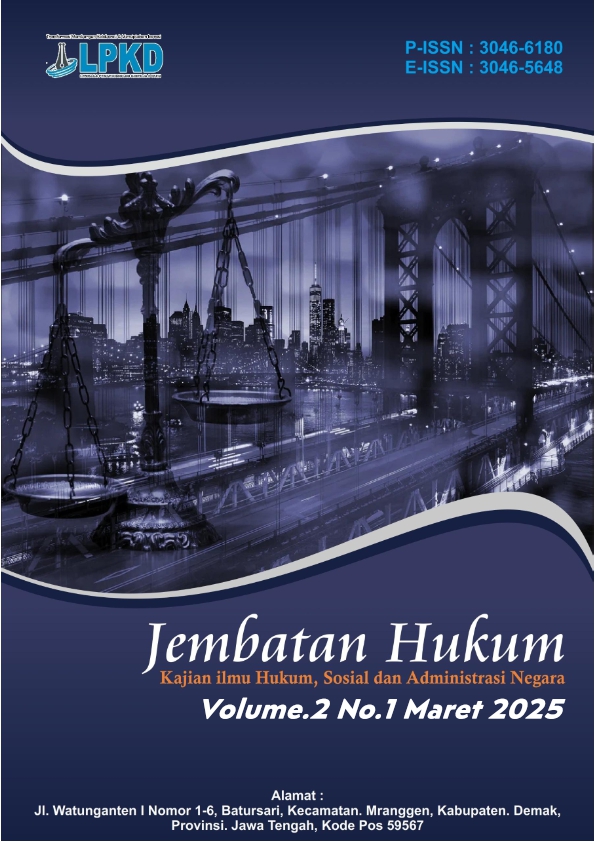
Efektifitas Penerapan Sistem Merid terhadap Prinsip Keadilan dan Kesetaraan dalam Menejeman PNS
DOI:
https://doi.org/10.62383/jembatan.v2i1.1226Keywords:
Merit System, Justice, Equality, Civil Servant Management, Bureaucratic ReformAbstract
Theimplementation of the merit system in civil servant management has shown its effectiveness in supporting the principles of justice and equality. However, to achieve more optimal results, efforts are needed to increase the capacity of human resources, strengthen supervision mechanisms, and enforce sanctions for violations. In addition, the government needs to encourage changes in organizational culture to better support the principle of meritocracy. Further studies are needed to evaluate the long-term impact of implementing the merit system at different levels of government. The merit system is a reflection of professional personnel management where the placement of employees and officials uses performance competencies and track records as a measure of appointment. The main purpose of the implementation of the merit system is to improve professionalism, fairness, and equality in the management of Civil Servants (PNS). The purpose of this research is to find out the Effectiveness of the Implementation of the Merid System on the Principles of Justice and Equality in Translating Civil Servants. This paper was carried out with the aim of finding out how the Implementation of the Effectiveness of the Implementation of the Merid System on the Principles of Justice and Equality in Translating Civil Servants by using a qualitative analysis method. so that it is expected to contribute thoughts to the government in the assessment and implementation of Merid Sytem towards a better direction.
References
Bewinda, R. N., Fauzy, R., & Daud, R. (2023). Sejarah sistem merit dalam manajemen sumber daya manusia sektor publik di Indonesia. Jurnal Ilmu Administrasi Publik, 6, 523. https://doi.org/10.12345/jiap.v6i2.6791
Bhudianto, W. (2015). Manajemen pegawai aparatur sipil negara menuju good governance. Jurnal Manajemen PNS, 1, 78.
Daryanto, A. (2007). Merit system dalam manajemen pegawai negeri sipil. Jurnal Kebijakan dan Manajemen PNS, 4(1), 12-20.
Hidayat, A., & Pramudya, M. (2018). Implementasi sistem merit dalam pengelolaan sumber daya manusia di sektor publik. Jurnal Manajemen Publik, 5(2), 122-134. https://doi.org/10.12345/jmp.v5i2.4567
Ismail, N. (2019). Merit system dalam mewujudkan transparansi pembinaan karier aparatur sipil negara. Jurnal Kebijakan Pemerintahan, X(1), 34-42. https://doi.org/10.12345/jkp.v10i1.9754
Kartina, R. H., & Krustiyati, A. (2023). Kepegawaian dalam pemerintahan di Indonesia (S. Murni, Ed.; 1st ed.). Damera Press.
Khobiburrohma, E. N., Margareta, P. S., & Hasbullah, M. H. (2020). Penerapan sistem merit dalam birokrasi Indonesia untuk mewujudkan good governance. Jurnal Ilmiah Ilmu Administrasi, 3, 139-140. https://doi.org/10.12345/jia.v3i1.2468
Nurhadi, S., & Widodo, M. (2021). Evaluasi penerapan sistem merit dalam pemerintahan daerah. Jurnal Kebijakan Pemerintahan Daerah, 7(1), 67-75. https://doi.org/10.12345/jkpd.v7i1.7890
Sandinirwan, I., Kharomah, R. U., Zubaedah, A., Sueb, M., & Syahraini, A. F. (2022). Faktor-faktor yang memengaruhi keberhasilan implementasi sistem merit dalam organisasi pemerintahan di Indonesia. Jurnal Administrasi Publik, 3, 1172-1173. https://doi.org/10.12345/jap.v3i2.3579
Setiawan, A. D. M., Salsabila, A., Jannah, L. M., & Ariyanti, F. (2022). Relevansi peraturan pemberhentian ASN terhadap sistem merit di Indonesia. Jurnal Ilmu Administrasi Publik, 4, 233-237. https://doi.org/10.12345/jiap.v4i2.1234
Tompoliu, S. R., Pondaag, A. H., & Gerungan, C. A. (2024). Implementasi sistem merit dalam organisasi pemerintahan: Tantangan dan solusi. Jurnal Administrasi Negara, 13(3), 8-15. https://doi.org/10.12345/jan.v13i3.1234
Wicaksono, A., Mulyo, H. H., & Riantono, I. E. (2015). Analisis dampak penerapan sistem ERP terhadap kinerja pengguna. Jurnal Teknologi Informasi, 6, 30-32. https://doi.org/10.12345/jti.v6i1.5678
Downloads
Published
How to Cite
Issue
Section
License
Copyright (c) 2025 Jembatan Hukum : Kajian ilmu Hukum, Sosial dan Administrasi Negara

This work is licensed under a Creative Commons Attribution-ShareAlike 4.0 International License.