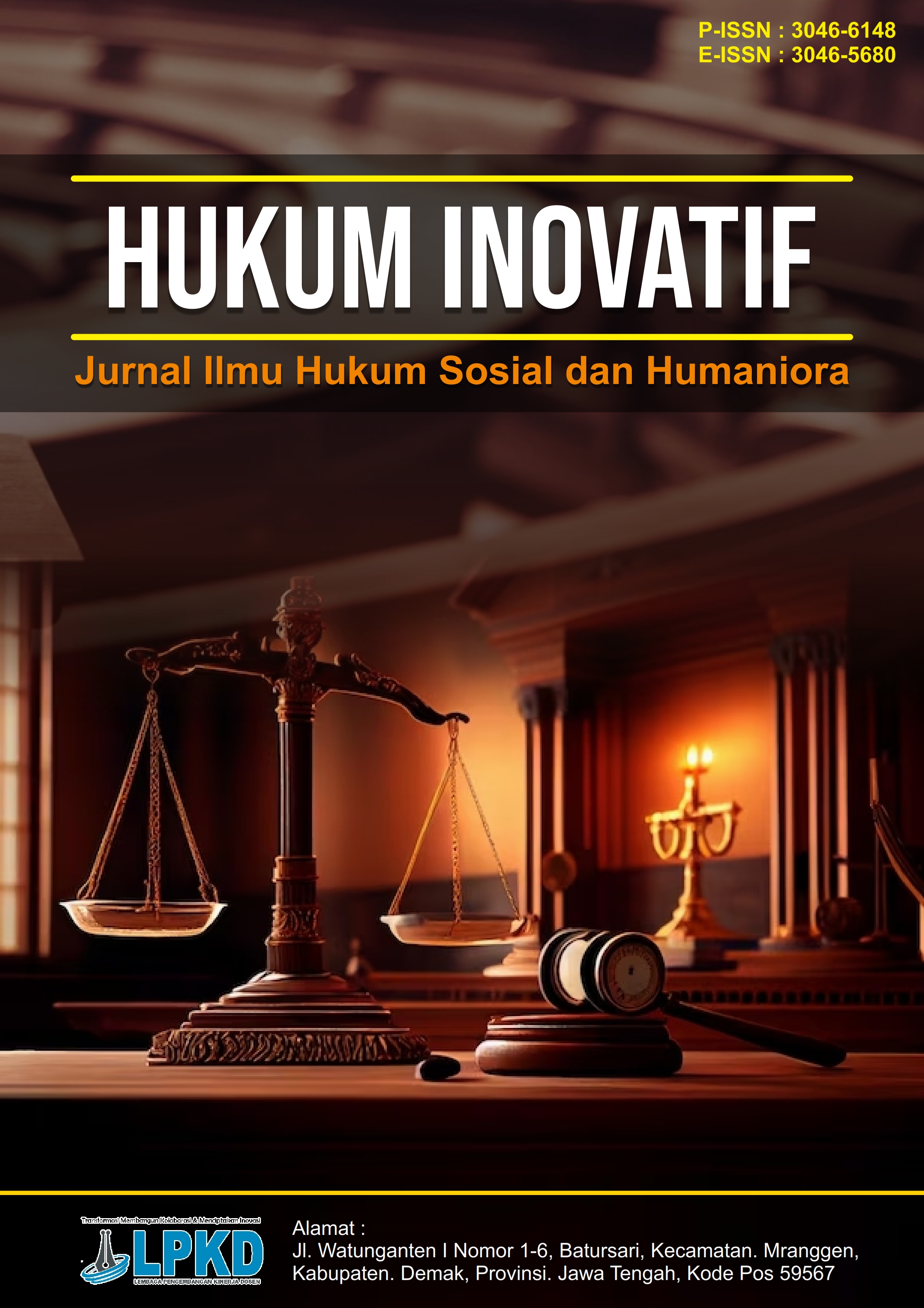
Keabsahan Pelimpahan Porsi Haji melalui Wasiat Wajibah dan Transformasi Hukumnya terhadap Hukum Islam
DOI:
https://doi.org/10.62383/humif.v2i4.2668Keywords:
Fiqh al-Nawāzil, Istislah, Maqāṣid al-Sharī'ah, Hajj portion, Obligatory WillAbstract
This study discusses the discourse of fiqh al-nawāzil which is rooted in the fundamental disparity between Islamic Family Law (classical inheritance and will law) and Contemporary Law (Hajj queue regulation Law No. 8 of 2019 and fiat of the transfer of one person to the Director General of PHU No. 130 of 2020). This background raises a normative dilemma when the right to worship (al-haq al-'ibādi) is threatened with forfeiture because classical instruments clash with the principle of lā waṣiyyata li wārith and the limits of al-thuluth. The main purpose of this research is to propose a Mandatory Will as a transformative solution of Islamic Law to provide a fair and strong sharia foundation for the existing state administrative policies. The method used is Fiqh al-Nawāzil with the approach of Istislah (Maslahah Mursalah) and Qiyās Istiḥsānī, which places the portion of Hajj as an obligation that must be fulfilled (al-wājib al-waṣiyyah) equivalent to debt, so that it can methodologically neutralize the limitation of classical inheritance. The conclusion shows that the Obligatory Will has succeeded in bridging this conflict, providing a Legal Impact in the form of modernizing Islamic Family Law, and affirming the ability of Islamic Law to realize maqāṣid al-sharī'ah (ḥifẓ al-dīn and ḥifẓ al-māl) in the contemporary era. The recommendation urges that amendments to the Compilation of Islamic Law (KHI) and hajj regulations (including the strengthening of Kepdirjen 130/2020) be immediately carried out to institutionalize the Obligatory Will, accompanied by the DSN/MUI Fatwa to prevent the commercialization (tadāwul) of the hajj portion and ensure substantive justice for the heirs.
References
Abū Dāwūd, S. I. A. A. (n.d.). Sunan Abī Dāwūd.
Ahmad, A. Z. (2018). Wasiat wajibah dalam perspektif hukum positif dan hukum Islam: Analisis maqāṣid asy-syarī‘ah Jasser Auda. Asy-Syir‘ah: Jurnal Ilmu Syari‘ah dan Hukum, 52(1), 55–73. https://doi.org/10.14421/ajish.v52i1.945
Al-Amruzi, M. F. (2014). Rekonstruksi wasiat wajibah dalam Kompilasi Hukum Islam. Aswaja Pressindo.
Al-Bukhari, A. ‘A. M. I. I. (n.d.). Ṣaḥīḥ al-Bukhārī.
Al-Shāṭibī, A. I. I. M. (2004). Al-Muwāfaqāt fī uṣūl al-sharī‘ah. Dār al-Kutub al-‘Ilmiyyah.
Al-Tirmidzi, M. I. ‘Ī. (n.d.). Sunan al-Tirmidzi.
Al-Zuḥailī, W. (1985). Al-fiqh al-islāmī wa adillatuh (Vols. 1–8). Dār al-Fikr.
Auda, J. (2008). Maqasid al-shariah as philosophy of Islamic law: A systems approach. International Institute of Islamic Thought. https://doi.org/10.2307/j.ctvkc67tg
Azzam, A. A. M. (2017). Fiqh al-nawāzil: Qaḍāyā fiqhiyyah mu‘āṣirah. Dār al-Kutub al-‘Ilmiyyah.
Khallāf, ‘A. A.-W. (1968). ‘Ilm uṣūl al-fiqh. Dār al-Qalam.
Muslim, A. A. M. I. A.-Ḥ. (n.d.). Ṣaḥīḥ Muslim.
Republik Indonesia. (1991). Instruksi Presiden Nomor 1 Tahun 1991 tentang Kompilasi Hukum Islam. Sekretariat Negara.
Republik Indonesia. (2006). Undang-Undang Nomor 3 Tahun 2006 tentang Perubahan atas Undang-Undang Nomor 7 Tahun 1989 tentang Peradilan Agama. Sekretariat Negara.
Republik Indonesia. (2019). Undang-Undang Nomor 8 Tahun 2019 tentang Penyelenggaraan Ibadah Haji dan Umrah. Sekretariat Negara.
Republik Indonesia. (2020). Keputusan Direktur Jenderal Penyelenggaraan Haji dan Umrah Nomor 130 Tahun 2020 tentang Penyelenggaraan Ibadah Haji dan Umrah. Sekretariat Negara.
Rohana, N. P. (2021). Wasiat wajibah dalam perspektif hukum di Indonesia. Yurisprudentia: Jurnal Hukum Ekonomi Syariah, 4(1), 70–85.
Sabiq, S. (1983). Fiqh al-sunnah (Vols. 1–5). Dār al-Fikr.
Sekoah, E. Y. (2025). Wasiat wajibah dalam KHI: Tinjauan maqāṣid syarī‘ah. AR-RA’YU: Jurnal Hukum Keluarga Islam, 1(1), 57–70.
Syafei, R. (2000). Fiqh mu‘amalah. Pustaka Setia.
Syarifuddin, A. (2011). Hukum kewarisan Islam di Indonesia. Kencana Prenada Media Group.
Downloads
Published
How to Cite
Issue
Section
License
Copyright (c) 2025 Hukum Inovatif : Jurnal Ilmu Hukum Sosial dan Humaniora

This work is licensed under a Creative Commons Attribution-ShareAlike 4.0 International License.